THE MOST INTERESTING
GRAFLEX REFLEX CAMERAS
and
THEIR UNIQUE
CHARACTERISTICS
Find your favourite camera on the site map
or
learn more about the development
on this page of the
GRAFLEX REFLEX CAMERAS
in the
A NEW ERA IN PHOTOGRAPHY
starting in the begin of the 20th century.
Up till then a ground glass
mounted to the back side of a huge camera which was placed on a tripod, forced
the poor photographer to bend forward
both hands on the camera and head covered with a black cloth, to be able to
focus.
The "subjects" were supposed to "freeze" until the exposure
had been finished.
The first decades in the new century the photographic world demanded a long
exposure time in which the
the subject moved away from the scene.
So, yes indeed it was about time for a new camera concept:
1) light in weight,
2) very fast exposure time
3) a tripod would be no longer needed anymore
4) what you see is what you get ground glass view.
5) reliable mechanic focusing and shutter release
6) revolving back for portrait and landscape
THE ANSWER WAS:
THE REFLEX CAMERA
At the start of the 20th century, a new era in photography sound very promising.
Indeed it was a start of a new generation of photographic camera building. Rather
than using a tripod,
these developments were based on the demand of handheld reflex cameras with
exposures of very short duration.
That said, it must not go unmentioned that plate and film sensitivity had been
increased dramatically and made
developing this new camera design possible.
What is a Reflex camera
and how does it works?
A reflex mirror is an essential part of an optical build-in
viewfinder system of a reflex camera.
For the first time in use at the beginning of the 20th century when reflex
cameras became popular.
The spring activated up-swinging mirror is positioned in the camera housing
directly behind the lens at a 45 degree angle. In fact this invention is still
used with the nowadays
analogue cameras.
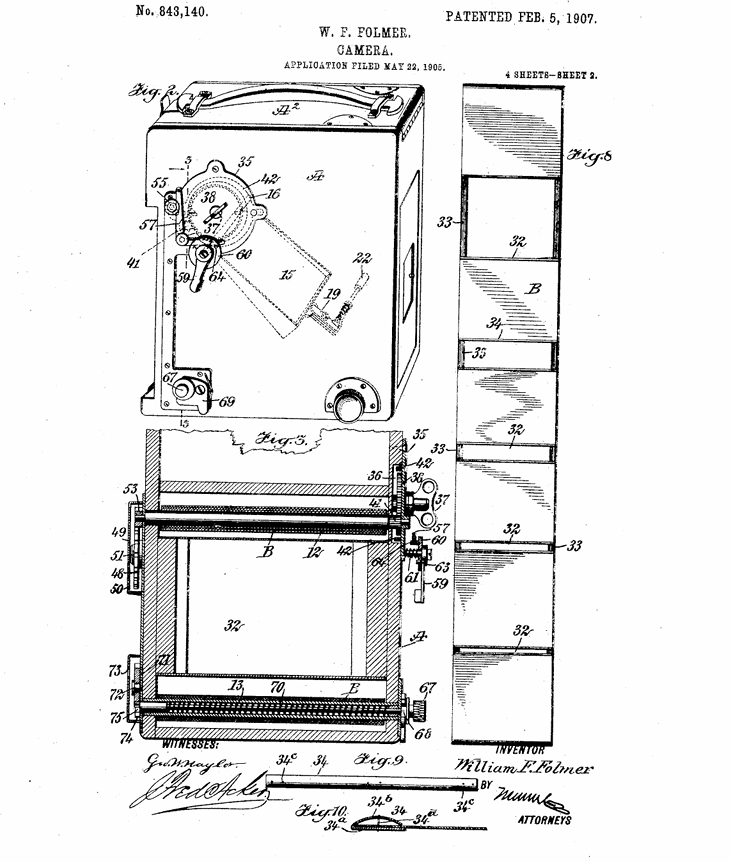
The 1907 patent by William F. Folmer shows the Auto Graflex design
with the (no.15) reflex mirror
in focusing position.
Its inventor was one of the founders of Folmer & Schwing camera works in
Rochester N.Y.
The at that time relatively
new first surface coated mirror in combination with a fast focal
plane shutter plus rack and pinion focusing lens
made it possible to focus with the use of a chimney shaped focusing hood, on
top of a horizontal placed ground glass screen.
Another great advantage was that the reflex mirror made it possible to
focus on the ground glass with its projected image right side up.
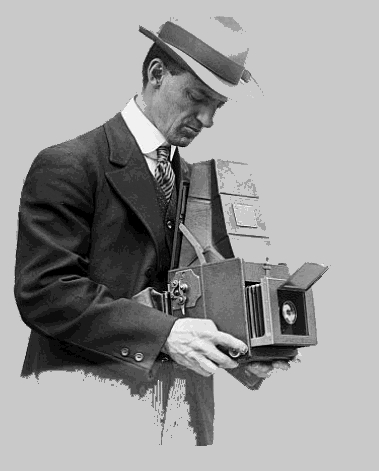
While watching the image on the ground glass, real time exposure had been made
possible by the ergonomic placed release-knob on the left front side of the
camera.
Supporting the camera with both hands, and a light pressure with the left thumb
on the release knob made the mirror swing up and at the same time released the
focal plane shutter to start its travel across the film surface.
William Formers uncomplicated designed Graflex Focal plane shutter existed out
of two rollers and one curtain with slits. The lower roller was spring loaded.
5 different fixed apertures openings in the curtain situated between these rollers
plus several settings of the spring tensions created a wide range of exposure
possibilities.
Below Folmer's 1905 Camera patent drawing
The Graflex focal plane shutter openings ranged from 1/8 inch to full opening
ensuring an absolute uniform aperture and definitely preferable to the double
adjustable curtains
of other reflex cameras which so often coursed a wedge formed unwanted
exposure opening.
His Graflex camera is a
cube shaped of any desired size and construction of which from top to bottom
a curtain shutter is passed, engaging with suitable guide rollers.
The upper end of the shutter is secured to a winding roller while the lower
end of the shutter is attached to a spring roller.
Both rollers being suitably placed in the sides of the camera house while the
guide rollers keep the shutter B in the right position.
At the rear of the camera an appropriate exposure opening for a film or plate
holder is provided.
In the mirror chamber a
spring controlled mirror closes the viewing hood shaft when the mirror is released.
When the mirror is down or set in focusing position it engages in a manner that
the rear of the mirror chamber is absolutely light tight.
Only in this setting the focal plane shutter can be set in the appropriate exposure
time even with the film holder "dark-slide open".
The mirror is held in focusing position as long as desired by a latch which
is pivoted upon a platform located in the inner chamber
and will be released at any time from the mirror by the release knob.


At the same time the curtain is drawn down from the top roller to the spring
loaded bottom roller.
One pre set section of the curtain including one of the various widths, passes
across the open frame to expose the plate or film.
The end of each opening (32) is defined by tapes (33) suitable connected to
the black out fabric of the shutter, while the longitudinal of the openings
are protected by metal strips.
The at that time relatively
new first surface coated mirror in combination with a fast focal
plane shutter plus rack and pinion focusing lens
made it possible to focus with the use of a chimney shaped focusing hood, on
top of a horizontal placed ground glass screen.
While watching the image on the ground glass, real time exposure had been made
possible by the ergonomic placed release-knob on the left front side of the
camera.
Supporting the camera with both hands, plus a light pressure with the left thumb
made the mirror swing up and at the same time released the focal plane shutter
to start its travel along the film surface.
This uncomplicated Graflex Focal plane shutter exists out of two rollers from
which the lower one was spring loaded.
5 different fixed apertures openings in the curtain between these rollers plus
several settings of the spring tensions created a range of exposure possibilities.
The Graflex focal plane shutter openings ranged from 1/8 inch to full opening
ensuring an absolute uniform aperture and definitely preferable to the double
adjustable curtains
which so often created a wedge formed exposure opening.
The Graflex Focal Plane shutter is composed around a single strip of opaque
fabric having transverse openings of different widths
and are arranged at different distances apart.
Another great advantage
was that the reflex mirror made it possible to focus on the ground glass
with the image right side up.
All this can be set and done by holding the camera with both hands on waist
level while focusing on the ground glass and releasing the shutter with the
thumb.
With the photographers head down, nobody of the persons in the scene feels "targeted"
which makes the reflex camera an excellent instrument for street photography.
However not every reflex
camera has these advantages.
Other designed cameras were equipped with complicated exposure settings which
are time consuming and more sensitive to interference.

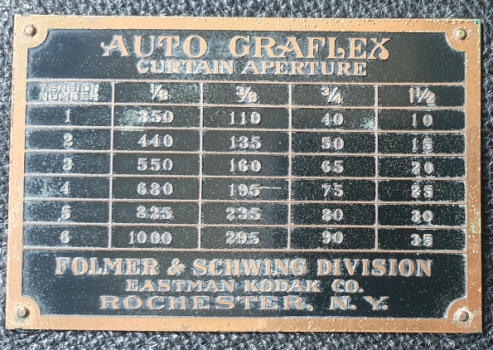
The Graflex shutter speed plate gives the approximate shutter speeds in fractional
parts of seconds,
obtainable with the various combinations of curtain apertures and tension
numbers.


From the begin of the 20th century when the Graflex Reflex cameras were introduced,
they became
loved by the press because of the many advantages mentioned here above.
Fast and reliable and for all relatively light in weight and easy to handle.
The reflex camera in combination with the semi automatic Grafmatic sheet film
holder or film-pack holder
made the Graflex Reflex cameras to the most popular press camera of that era.
Practically all these new reflex cameras were introduced in three sizes: 3¼x4¼
- 4x5 - 5x7 inch.
All of them had a stationary and later on even a reversible Graflex Back, an
interchangeable lens board and a focal plane shutter with speeds from 1/10 to
1/1000 sec.
The first camera in this segment, the
Auto Graflex had a front hinged cover and an bizarre looking completely
closed accordion hood with peep hole.
The peep hole was a simple cut out on the back side of the accordion hood. The
ground glass became visible looking downwards.
The mirror was placed opposite the peep hole as an alternative to see
the ground glass while looking strait on.
Another eye catching difference was the button shutter release.
As from 1911 Auto Graflex had the normal front hinged cover with the well known
chimney folding hood and a regular release lever.
The Auto Graflex remained until 1923 when the camera was replaced by the Series
B which body was inherited from the
also stationary back Auto Graflex, but had a fixed lens in threaded mount.
Activating the focusing knob opened the pop up lens cover automatically.
Mounted on a rack and pinion track, the lens was connected to the inner mirror
housing by a non tapered small bellows .
Series B the big (5x7) had a personal look with its curved upper part on top
of the front.
Later manufactured Graflex reflex cameras in this segment were:
Check my site map for more information about
Graflex Series B
Graflex Series C 1926-1935
Revolving Back Film Size 3 ¼ x 4 ¼
4x5 inch Graflex Super D
1941-1963
Updated version of the Series D
Only two tensions Low and High.
Like Series D with semi-automatic diaphragm 190 mm
Drop Curtain 1/5 sec
Sync outlet 1/1000 on aperture plate.
Factory conversion Graflok Back.
Back to Graflex Reflex Cameras